


Perfume glossary: 60 fragrance terms simply explained – from Absolue to Civet
From Absolue to Civet: 60 technical terms from the world of perfume, each explained in two to three sentences. With a concentration table and links to our in-depth guides.
A perfume glossary with 60 terms, in alphabetical order from Absolue to Civet. Each entry explains a technical term in two to three sentences – no jargon, and with links to our in-depth guides.
In short: Most fragrance terms describe either the performance of a scent (projection, sillage, longevity), its structure (top, heart and base notes, accord, fragrance family), its concentration (from Eau Fraîche to Extrait de Parfum) or a raw material (such as iris, vetiver or Ambroxan). Once you know these four groups, you can understand almost any fragrance description.
Jump to: A · B · C · D · E · F · G · H · I · K · L · M · N · O · P · R · S · T · V · Z
Concentrations at a glance
| Name | Usual fragrance oil content | Typical perceptibility |
|---|---|---|
| Eau Fraîche | approx. 1–3 % | under 1 hour |
| Eau de Cologne | approx. 2–5 % | 1–2 hours |
| Eau de Toilette | approx. 5–15 % | 3–5 hours |
| Eau de Parfum | approx. 15–20 % | 5–8 hours |
| Extrait de Parfum | approx. 20–40 % | 8 hours or more |
These ranges are industry guidelines, not legal limits. How long a fragrance actually lasts also depends on its raw materials, your skin type and the temperature.
A
Absolue
A highly concentrated fragrance material obtained from flowers or resins by solvent extraction rather than distillation. Absolutes capture delicate flowers such as jasmine or rose particularly true to nature and are among the most expensive raw materials.
Accord
Several raw materials that together create a new, distinct impression – like notes in music. Leather, amber or sea breeze are not single ingredients but accords made from several components.
Aldehydes
Synthetic fragrance materials with a sparkling, soapy character often described as "clean". In small amounts they make floral notes appear more radiant; they became famous through the great women's fragrances of the 1920s.
Amber
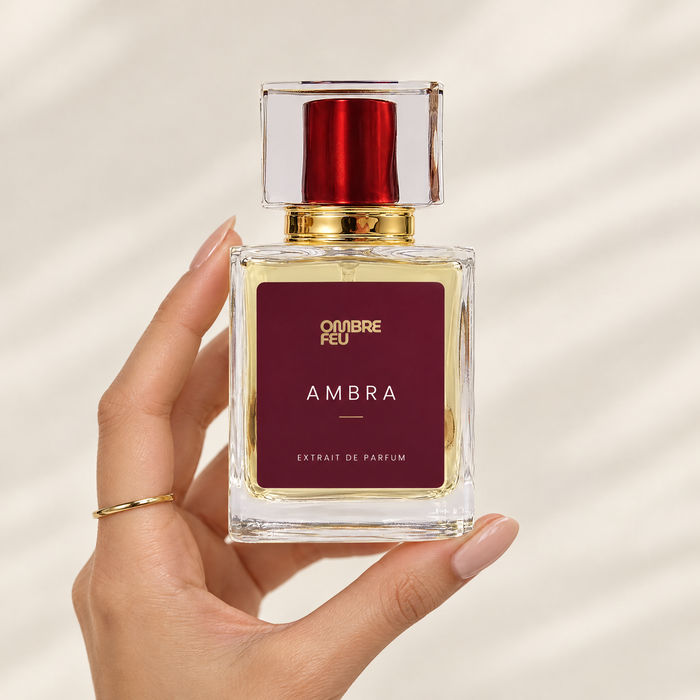
A warm, resinous-sweet accord, classically made from labdanum, vanilla and benzoin. Amber is neither fossil amber nor ambergris but a fragrance direction. Our women's fragrance Ambra has bourbon vanilla and Ambroxan in its base. Learn more →
Ambroxan
A synthetic fragrance material with a warm, woody, slightly mineral character. It was developed as a substitute for rare natural ambergris and gives fragrances radiance and longevity.
Animalic notes
Notes reminiscent of skin, fur or leather, such as musk, civet or castoreum. In reputable perfumes today they come from synthetic raw materials, no longer from animals.
B
Base note
The longest-lasting layer of a fragrance, still on the skin after hours. Typical examples are woods, resins, vanilla, musk and amber. The base shapes the impression others notice for the longest time. Learn more →
Benzoin
A balsamic resin from the bark of the styrax tree with a soft, vanilla-like scent. Benzoin is a classic building block of the amber accord and rounds off warm compositions.
Bergamot
A citrus fruit grown mainly in Calabria. Its oil is one of the most important top notes in perfumery: fresh, slightly bitter and floral at the same time. Some of its components are used in limited amounts because of their sensitivity to light.
Blind buy
Buying a fragrance without having tested it on your own skin first. The risk drops considerably if you can read a fragrance pyramid and know which fragrance families suit you. Learn more →
C
Cashmeran
A synthetic fragrance material with a soft, musky-woody character, often referred to as cashmere wood. It is reminiscent of warm wool and gives fragrances a velvety depth.
Batch code
A number on the bottle or packaging that identifies a production batch. It is required for traceability and helps distinguish genuine products from fakes. Learn more →
Chypre
A classic fragrance structure of bergamot, oakmoss, labdanum and patchouli – dry, earthy and elegant. The name goes back to Cyprus. Because of restrictions on oakmoss, modern chypres work with substitutes.
Coumarin
A fragrance material with a hay-like, sweet, slightly almond-like scent, found naturally above all in the tonka bean. Coumarin is a basic building block of fougère fragrances and is one of the fragrance materials that must be declared.
D
Decant
An original fragrance transferred into a small vial. Decants are a popular way to test a fragrance over several days before buying a full bottle. Learn more →
Dry-down
The phase in which a fragrance has settled: the top notes have evaporated and the heart and base carry the scent. The dry-down is what you and others smell most of the time – so only judge a fragrance after it.
Fragrance family
The category a composition is assigned to, for example fresh, floral, woody, amber or gourmand. Fragrance families help you put your preferences into words and choose new fragrances more deliberately. Learn more →
Fragrance pyramid
The representation of a fragrance in three phases: top note, heart note and base note. It follows the weight of the molecules – light ones evaporate first, heavy ones last the longest. Learn more →
Dupe
A fragrance deliberately modelled on a well-known original but sold under its own name. Dupes can smell similar but often differ in raw materials, development and longevity. Learn more →
E
Eau de Cologne
A light concentration level, usually with around 2–5 % fragrance oil. Eau de Cologne feels fresh and zesty but is typically barely noticeable after one to two hours.
Eau de Parfum
A concentration level usually with around 15–20 % fragrance oil. Eau de Parfum is the most common form today and generally lasts several hours on the skin. Learn more →
Eau de Toilette
A concentration level usually with around 5–15 % fragrance oil. Eau de Toilette is lighter and fresher than Eau de Parfum and works well for summer and the office. Learn more →
Eau Fraîche
A very light concentration level, usually with around 1–3 % fragrance oil, often with little or no alcohol. Intended as a quick refresher, not as an all-day fragrance.
Oakmoss
A lichen that grows on oak trees, with an earthy, mossy, slightly leathery scent. It is the heart of classic chypre and fougère fragrances and today, because of allergy risks, is only used in a heavily restricted, purified form.
Extrait de Parfum
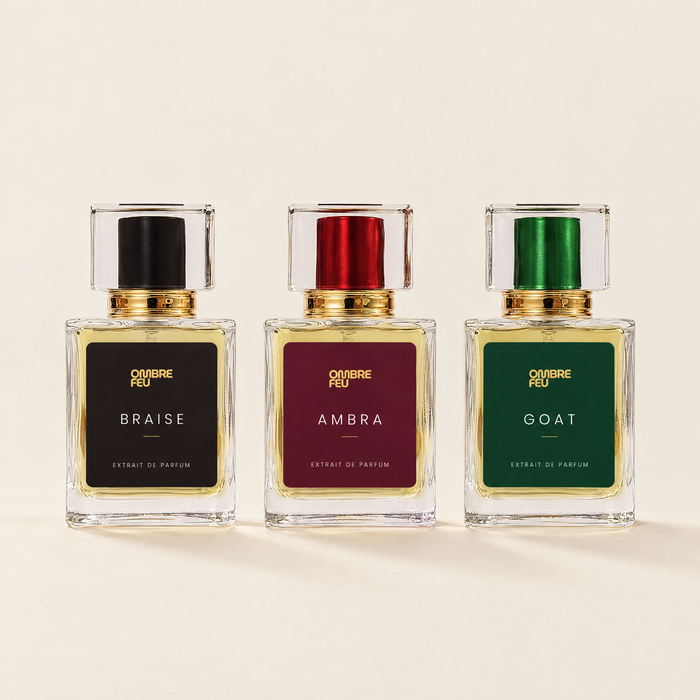
The highest concentration level, usually with around 20–40 % fragrance oil. Extraits last the longest and often sit closer to the skin. All three Ombre & Feu fragrances are Extraits de Parfum. Learn more →
F
Fixative
A raw material that binds more volatile components and keeps a fragrance on the skin for longer. Typical fixatives are resins, musks, Ambroxan and heavy woods.
Flanker
A variation of an existing fragrance under the same name with an addition such as Intense, Elixir or Sport. Flankers can smell quite different from the original.
Fougère
French for fern. One of the oldest structures for men's fragrances, built on lavender, oakmoss and coumarin. If a fragrance feels "classically masculine, like a good barbershop", it is often a fougère.
G
Gourmand
A fragrance direction that puts edible notes in the foreground: vanilla, caramel, chocolate, coffee or honey. Gourmands belong to the amber family and divide opinion more than any other direction.
H
Heart note
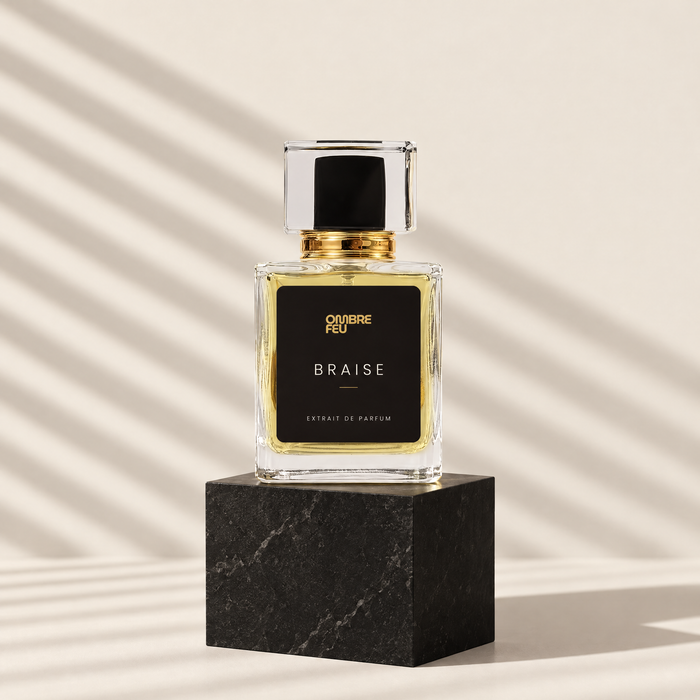
The middle layer of a fragrance, which comes to the fore after the top notes and usually carries the scent for several hours. This is often where flowers, spices and aromatic herbs sit – in Braise, for example, cinnamon, saffron and iris. Learn more →
I
IFRA
The international association of the fragrance industry. Its standards determine which raw materials may be used and in what maximum amounts, and they are the most common reason for reformulations.
INCI
The internationally standardised naming system for cosmetic ingredients. In the EU, every package must list the ingredients in this form, in descending order of quantity. Learn more →
Iris
A powdery, woody fragrance material from the root of the iris plant, also known as orris. The roots mature for several years before they are processed – which is why iris is one of the most precious raw materials.
Iso E Super
A synthetic fragrance material with a velvety, woody character that is hard to pin down. Many people barely notice it consciously, yet it gives fragrances volume and a light, close-to-the-skin radiance.
K
Concentration
The share of fragrance oil in a perfume. The higher the concentration, the longer a fragrance generally lasts. The levels from Eau Fraîche to Extrait are not defined by law and vary from manufacturer to manufacturer.
Top note
The first layer of a fragrance, which dominates in the first few minutes after application. Typical examples are citrus fruits, fresh herbs and light spices. It is loud but short-lived. Learn more →
L
Labdanum
The resin of the rockrose, a Mediterranean plant, with a warm, leathery, balsamic scent. Labdanum is a core component of amber and chypre accords.
Layering
Combining several fragrance products, such as shower gel, body lotion and perfume, or two perfumes. Combined well, it extends the effect; combined badly, it works against the fragrance. Learn more →
Longevity
How long a fragrance lasts in hours, i.e. how long it remains noticeable on the skin. It depends on concentration, raw materials, skin type and application technique. Learn more →
M
Maceration
The maturing of a freshly blended fragrance composition in alcohol before bottling. During this time the components bond and the fragrance becomes rounder.
Musk
A group of soft, close-to-the-skin fragrance materials with a character ranging from clean to warm and sensual. Natural musk from the musk deer is no longer used; today only synthetic musks are used.
N
Nose blindness
Your sense of smell getting used to a constant stimulus, technically known as olfactory adaptation. After around 20 to 30 minutes you hardly notice your own fragrance any more – but others still do. Learn more →
Neroli
An essential oil from the blossoms of the bitter orange, obtained by steam distillation. Neroli smells fresh, floral and slightly honeyed and is a classic in eau de Cologne.
Niche fragrance
A perfume from a usually smaller brand that deliberately sets itself apart from the mass market – often with more unusual raw materials, higher concentrations and smaller production runs. Learn more →
O
Oud
The dark, resinous wood of the agarwood tree, which only forms after a fungal infection. Real oud is extremely rare and expensive, so most perfumes use oud accords instead.
Oxidation
The reaction of fragrance materials with oxygen, accelerated by light and heat. It makes the top notes turn first and is the reason why proper storage makes such a difference. Learn more →
P
Perfumer
The person who designs and fine-tunes a fragrance composition, also known in the trade as a "nose". Training takes many years; an experienced perfumer can recognise thousands of raw materials by smell. Learn more →
Patchouli
An essential oil from the dried leaves of the patchouli plant with an earthy, woody, slightly sweet scent. Patchouli is a cornerstone of chypre fragrances and many modern amber compositions.
Projection
The radius within which a fragrance can be perceived while you are present. High projection fills a room, low projection is only noticeable at arm's length – both can be intended. Learn more →
Pulse points
Areas where blood vessels lie close beneath the skin, such as the neck, the nape, the wrists and the insides of the elbows. The warmth there helps the fragrance unfold evenly. Learn more →
R
Reformulation
The revision of an existing formula, usually because of changed regulations or the availability of raw materials. The name stays, the fragrance changes – often the reason behind the phrase "it used to smell different".
S
Sandalwood
A creamy, soft wood with a milky, slightly sweet scent. East Indian sandalwood is strictly regulated and scarce, which is why Australian sandalwood or synthetic building blocks are often used.
Signature scent
The one fragrance others associate with you and that you wear over a long period. It usually doesn't come from a single purchase but from trying things out and wearing them again and again. Learn more →
Sillage
French for the wake of a boat: the scent trail that remains after you have left a room. Strong sillage usually comes from musk, amber and resin notes. Learn more →
Skin scent
A fragrance or fragrance phase that sits so close to the body that you can only smell it from a few centimetres away. Some perfumes are deliberately composed this way – it is intentional, not a flaw.
T
Tester
Genuine product in plain packaging, originally intended for retailers. In terms of content, a tester is identical to the retail version and should not be confused with a fake. Learn more →
Tonka bean
The seed of the South American tonka tree with a warm, almond-like, vanilla-like scent. Its main fragrance compound is coumarin. Tonka features in many men's fragrances, including the base of Braise. Learn more →
V
Vanillin
The most important fragrance compound of the vanilla pod, today mostly produced synthetically. Vanillin gives fragrances warmth and sweetness and is the basis of many amber and gourmand compositions.
Vetiver
An essential oil from the roots of a tropical grass with a smoky, earthy, woody character. Vetiver gives compositions depth and is particularly common in men's fragrances.
Z
Civet
Originally a glandular secretion of the civet cat with a strongly animalic smell. In modern perfumery, civet is replaced exclusively by synthetic fragrance materials.
Frequently asked questions
What is the difference between sillage and projection?
Projection is the radius around you while you are there. Sillage is the trail that remains once you have left. A fragrance can project very little and still leave a noticeable trail.
Is amber the same as ambergris?
No. Amber is an accord of resins and vanilla. Ambergris is a rare natural raw material from the sperm whale, which today is practically always replaced by synthetic materials such as Ambroxan.
Which concentration lasts the longest?
Extrait de Parfum, usually at 20–40 %, has the highest share of fragrance oil and generally lasts the longest. But the raw materials matter too: woody, resinous and musky notes last longer than citrus notes.
Last updated: October 2026 · By Firat Tarti, founder of Ombre & Feu Fragrance, made in Germany.
Discover all Ombre & Feu fragrances → · Try first: 2 ml sample →
- Eau de Cologne, Eau de Toilette, Eau de Parfum, Extrait de Parfum: the differences
- New: Lune Dorée – our captivating Extrait de Parfum for women
- Neu: Nuit Bédouine – unser fruchtig-holziger Extrait de Parfum für Herren
- Ombre & Feu Merch: Hoodies, T-Shirt, Gilet and Accessories at a Glance
- A Small Gift with Fragrance: Perfume Samples for Secret Santa and St Nicholas' Day
- Perfume for New Year's Eve: Which Scent Lasts All Night?
- Perfume for the Christmas Party: Subtle, Warm and Just Right
