


Eau de parfum or eau de toilette? The difference, explained simply
Eau de Parfum contains around 15–20 % fragrance oil and usually lasts 5–8 hours; Eau de Toilette contains around 5–15 % and usually lasts 3–5 hours. What that means for intensity, cost per day of wear and your buying decision.

Two bottles, the same fragrance name, thirty euros apart. One says “eau de toilette”, the other “eau de parfum”. The difference is not marketing – it is measurable. And it decides how long your fragrance lasts and how close someone has to come to smell it.
In short: Eau de parfum and eau de toilette differ mainly in one respect: the share of fragrance oil. An eau de toilette usually contains around 5 to 15 per cent and typically lasts three to five hours; an eau de parfum contains around 15 to 20 per cent and usually lasts five to eight hours. A higher concentration means longer and deeper – not automatically louder.
- Everyday wear, all day long: eau de parfum
- Summer, heat, the office: eau de toilette
- Special evenings, very close to the skin, maximum longevity: extrait de parfum
- Work out the price per day worn, not per millilitre
The only difference that matters: concentration
At its core, every perfume consists of three things: fragrance oils, alcohol as a carrier and a small amount of water. The designation on the bottle tells you nothing other than the share of fragrance oils. The higher it is, the more intense and long-lasting the fragrance – and the more expensive it is to make.
Everything else that often gets sold as a difference – “higher-grade raw materials”, “finer bottling” – is not a property of the concentration level but a decision made by the house.
The concentration levels at a glance
| Designation | Fragrance oil share | Longevity on skin | Best suited for |
|---|---|---|---|
| Eau de Cologne (EdC) | approx. 2–5% | 1–2 hours | A refresher, very hot days |
| Eau de Toilette (EdT) | approx. 5–15% | 3–5 hours | Summer, the office, daytime fragrance |
| Eau de Parfum (EdP) | approx. 15–20% | 5–8 hours | All day, autumn and winter, evenings |
| Extrait de Parfum | approx. 20–40% | 8–12 hours and more | Special occasions, very close to the skin, long days |
The percentages are guide values, not a standard. No law defines the point at which something may be called “eau de parfum” – reputable houses stick to these ranges all the same. If you want to be sure, test the longevity yourself: a fragrance that has vanished after four hours was not an eau de parfum, whatever the bottle says.
And what do “Parfum”, “Intense” or “Eau Fraîche” mean?
Besides the four classic levels, other terms appear on bottles. “Parfum” on its own or “Extrait” usually means the highest concentration. “Intense”, “Elixir” or “Absolu”, on the other hand, are not fixed levels but name additions used by individual houses – they often hint at a denser, warmer version, but say nothing binding about the fragrance oil share. “Eau Fraîche” or “Splash” generally refers to very light compositions, below even an eau de toilette. If you want to know for sure, all that counts in the end is what the fragrance does on your skin. We explain the highest level in detail in Extrait de Parfum: what is it?.
A higher concentration does not automatically mean “louder”
A widespread misconception: an extrait is a cloud of perfume, an eau de toilette a whisper. In reality it is often the other way round. Because it contains less alcohol, a highly concentrated fragrance evaporates more slowly – it stays closer to the body and therefore feels more intimate, not louder.
Reach, which the fragrance world calls “sillage”, depends more on the raw materials used than on the concentration. An eau de toilette with plenty of musk and Ambroxan can fill a room far more than an extrait built on iris and sandalwood.
Remember the split like this: concentration mainly governs duration, the raw materials govern reach. What sillage, projection and longevity mean in detail is explained in our glossary of perfume terms.
The same fragrance in two concentrations does not smell the same
This is the part hardly anyone expects: when a house offers the same fragrance as an eau de toilette and as an eau de parfum, these are usually two different compositions – not the same liquid at two strengths.
In the toilette version the fresh top notes are generally reinforced so that the fragrance makes an immediate impression despite the lower concentration. In the eau de parfum the weight lies on the heart and base – on wood, resin, vanilla and amber. That is why it is worth testing both rather than automatically reaching for the more expensive version. How this structure shifts over the course of the day is explained in our article on top note, heart note and base note.
How a day with both versions unfolds
Imagine you apply the toilette version to your left wrist at eight in the morning and the eau de parfum of the same fragrance to your right. In the first half hour the left side often seems brighter and zestier, the right already rounder. By midday the left usually has only a quiet skin scent left, while on the right the heart is only just coming into its own. By late afternoon you can barely smell anything on the left – on the right the base is still going, soft and close. This progression is the real difference you pay for when you buy.
Eau de toilette or eau de parfum: which level for which occasion?
The question “Which is better?” has no one-size-fits-all answer. It depends on when, where and for how long you wear your fragrance. This overview helps you decide:
| Situation | Suitable level | Why |
|---|---|---|
| Hot summer day, lots of time outdoors | Eau de toilette | Heat amplifies every fragrance; lighter is more pleasant here |
| Open-plan office, long working day | Eau de parfum or a sparingly dosed extrait | Lasts until the evening without reapplying |
| After sport, a quick refresher | Eau de cologne or eau de toilette | Should work fast and fade just as fast |
| Autumn and winter evening, dinner | Eau de parfum or extrait | Cold slows evaporation; warm base notes need substance |
| Travel, a long day without reapplying | Extrait de parfum | Small amount, long-lasting effect |
One important point: the level is only half the answer. A fresh, bright fragrance at a high concentration can work better in summer than a heavy eau de toilette. So always pay attention to both – the concentration and the fragrance family.
What does a day of wear really cost you?
The price per millilitre is the most misleading figure in perfumery, because it ignores how much you need per application. Calculate it this way instead: one spray releases about 0.1 millilitres.
| Concentration | Sprays per day | Consumption | Days of wear from 50 ml |
|---|---|---|---|
| Eau de Toilette | 4 | approx. 0.4 ml | approx. 125 |
| Eau de Parfum | 2–3 | approx. 0.25 ml | approx. 200 |
| Extrait de Parfum | 1–2 | approx. 0.15 ml | approx. 330 |
An eau de parfum at €80 therefore costs around 40 cents a day. An eau de toilette at €60 comes to almost 50 cents – even though it was cheaper per millilitre. The figures are averages and depend on the atomiser and dosage, but the direction holds in almost every case.
With a 50 ml extrait at €49.90, like Braise, the same calculation brings you to around 15 cents per day of wear – provided you stick to one or two sprays. An extrait usually doesn’t need more than that anyway.
How to test the difference yourself
The details on the bottle are a start. You will only really know what a fragrance can do on your own skin. Here is how to go about it:
- Clean, unscented skin. No deodorant with its own scent, no fragranced lotion on the test spot.
- One spray per spot. For example, one concentration on the left, the other on the right. Don’t rub.
- Note the times. Smell after ten minutes, after one hour, after four and after eight hours.
- Ask someone. Your nose gets used to the fragrance. Another person will tell you more honestly how far it carries.
- Repeat on a second day. Temperature and how you feel that day change the result.
Incidentally, it is perfectly normal for the same fragrance to last for different lengths of time on two people. The reasons are explained in Why does perfume smell different on everyone?.
Three misconceptions about eau de parfum and eau de toilette
- “Eau de toilette is for men, eau de parfum for women.” Concentration has no gender. This assignment comes from old marketing habits, not from chemistry.
- “More sprays turn an eau de toilette into an eau de parfum.” You get more quantity, but not more depth. The composition remains designed for freshness and still fades sooner.
- “A high concentration is only for winter.” An extrait can be worn in summer too – with one spray instead of two, ideally on a covered spot.
What else is on the bottle?
Besides the concentration level, every fragrance sold in the EU carries further details that help you place it:
- The nominal fill quantity in millilitres – the basis for the unit price that retailers must state under the German Price Indication Ordinance.
- The INCI list – all ingredients in descending order of quantity. Alcohol almost always comes first.
- Fragrance substances subject to declaration such as linalool, limonene or coumarin. They are not a quality defect but natural components of many raw materials, which have to be listed because of possible allergies.
- The batch number – with many houses this lets you work out the bottling date. Useful for bottles bought second-hand.
- The open jar symbol with a number such as “36M” – it shows how many months the product keeps after opening.
How to read an INCI list step by step is explained in Reading perfume ingredients and allergens. You will find our own details under Ingredients and product safety.
What should you buy?
An honest guide to help you decide:
- You want a fragrance that outlasts the day – eau de parfum or extrait. The best balance of longevity, depth and price per day of wear.
- You mainly wear fragrance in summer or at the office – eau de toilette. Lighter, less intrusive, more pleasant in the heat. Or a fresh extrait, sparingly dosed.
- You are looking for something very personal for special evenings – extrait. Worn close and long.
- You don’t own a fragrance yet – start with a higher concentration. It is the most forgiving of mistakes in application.
And whatever the level: application technique often makes more of a difference than concentration. Our seven most common application mistakes and the nine tips for better longevity go into this.
Why Braise is an Extrait de Parfum
Braise lives from its base: leather, vanilla, tonka bean, tobacco, sandalwood and amber. These raw materials need concentration and time to unfold – in a lighter toilette version they would be gone after two hours, leaving only the spicy opening, which is really only meant to open the door.
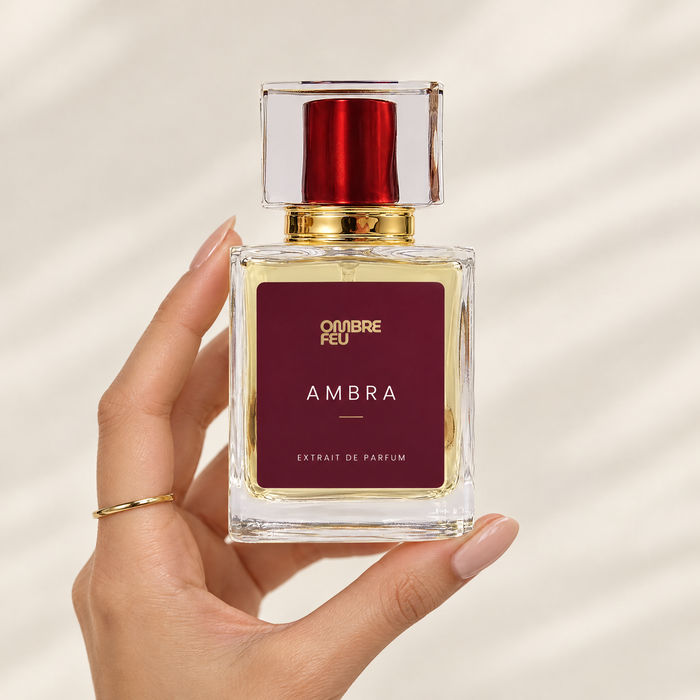
That is why Braise is an extrait de parfum with 30% fragrance oil in 50 ml, bottled in Germany. On the skin it lasts 12–18 hours – a range that depends on skin type and temperature. GOAT and Ambra from our collection are also extraits at the same concentration. This shows nicely that concentration does not mean heaviness: GOAT is radiant and sweet-woody with blood orange, fig and honey, a men’s fragrance for day and evening, all year round – and still never heavy. Why we chose the sweet-woody fragrance family for Braise is explained in our article on sweet-woody men’s fragrances, and the full fragrance pyramid is on The Fragrances.
Conclusion
Eau de parfum or eau de toilette – the difference lies in the fragrance oil, and it shows over hours, not in the first few minutes. The eau de toilette is light and quick, the eau de parfum deeper and more enduring, the extrait closest to the skin and there the longest. Decide according to your day, not the price per millilitre, and test on your own skin. Anyone who has experienced a warm base still glowing in the evening, long after the morning has passed, knows what they are paying for with the higher concentration.
Frequently asked questions
What is the difference between eau de parfum and eau de toilette?
The proportion of fragrance oil. An eau de toilette contains around 5 to 15 per cent fragrance oil, an eau de parfum around 15 to 20 per cent. As a result the eau de parfum lasts longer – typically five to eight hours instead of three to five – and its base notes come through far more clearly.
Is eau de parfum always better than eau de toilette?
No. It is more concentrated and lasts longer, but “better” depends on the occasion. On a hot July day or in an open-plan office, an eau de toilette can be the clearly more pleasant choice, because heat intensifies sweetness and weight.
Why does my eau de parfum still only last three hours?
Usually it comes down to dry skin, incorrect storage, or the fact that you have grown used to the fragrance and no longer perceive it yourself. Others can still smell it. The most common causes and what helps against them are set out in our seven mistakes when applying perfume.
What does “parfum” on its own on the bottle mean?
In specialist retail it means extrait de parfum, the highest concentration level with 20 to 40 per cent fragrance oil. Colloquially, however, “perfume” is used for any fragrance, regardless of the concentration.
Is eau de parfum more expensive than eau de toilette?
Per millilitre yes, usually by 20 to 40 per cent. Per day worn, often not: with an eau de parfum you need two sprays, with an eau de toilette three to four for a comparable effect. So calculate in days worn rather than in millilitres.
Is there a legal rule governing these designations?
No. There is no binding standard specifying the fragrance oil content from which a product may be called eau de parfum. The ranges quoted are industry convention. Reputable houses adhere to them, but a look at longevity in testing says more than the designation on the bottle.
Which concentration is suited to summer?
For hot days an eau de toilette or an eau de cologne, because warmth speeds up evaporation anyway and heavy base notes quickly become overwhelming. An eau de parfum still works in summer – but then in the evening and with one spray less.


- Eau de Cologne, Eau de Toilette, Eau de Parfum, Extrait de Parfum: the differences
- New: Lune Dorée – our captivating Extrait de Parfum for women
- Ombre & Feu Merch: Hoodies, T-Shirt, Gilet and Accessories at a Glance
- A Small Gift with Fragrance: Perfume Samples for Secret Santa and St Nicholas' Day
- Perfume for New Year's Eve: Which Scent Lasts All Night?
- Perfume for the Christmas Party: Subtle, Warm and Just Right
- Christmas Gift for Her: How to Find the Right Perfume
