


How is a perfume made? From the idea to the finished bottle
A perfume is made in eight steps: briefing, composition, modifications, blending, maturation, chilling and filtration, filling and safety assessment. The journey from idea to finished bottle, step by step.

A perfume seems like something fleeting – a few sprays, an impression that changes over the day. Behind it lies a process that often takes longer than a year and has more to do with craft, patience and rules than you might think. Here is the journey from the first thought to the bottle on the shelf.
A perfume is made in seven steps: idea and brief, composition, modifications, production of the concentrate, blending with alcohol and maturation, chilling and filtration, filling. Running in parallel is the legally required safety assessment, without which no fragrance may be sold in the EU.
- A fragrance often goes through dozens to hundreds of versions
- After blending, it needs weeks to mature
- Chilling and filtration make it clear and stable
- No safety assessment and EU notification, no sale
The seven steps at a glance
| Step | What happens | Typical duration |
|---|---|---|
| 1. Idea and brief | Image, mood and target audience are described | Days to weeks |
| 2. Composition | A first formula sets the direction | Weeks |
| 3. Modifications | Version after version is tested and adjusted | Months |
| 4. Concentrate | Fragrance oil is weighed out exactly according to the formula | Days |
| 5. Blending and maturation | Dilution with alcohol, resting period (maceration) | Weeks |
| 6. Chilling and filtration | Cloudy particles settle out and are removed | Days |
| 7. Filling and inspection | Bottle, atomiser, label, batch number | Days |
These timings are rough guidelines. How long a fragrance actually takes depends above all on the third step – and that one cannot be rushed.
1. The idea and the brief
It starts not with a raw material, but with an image. A feeling, a time of day, a place. This becomes a brief: a description of what the fragrance should express, who it is for, when it is worn and how it should stand apart from others. Good briefs are surprisingly specific. “Masculine and elegant” helps no one. “The warmth that remains long after the evening has fallen quiet”, on the other hand, does.
A good brief usually answers four questions: What mood should it create? In which situation will the fragrance be worn – office, evening, summer, winter? How close or how far should it project? And what should it explicitly not be? That last question in particular saves many detours later on.
2. The composition
A perfumer translates this description into a formula. They work with a palette of several hundred raw materials – natural oils and extracts as well as synthetic molecules – and know each one on its own, in combination and at different concentrations.
The first formula is a draft. It sets the direction: which fragrance family, which opening, which base. What belongs in the top, heart and base follows the weight of the molecules. The basics are covered in Understanding fragrance notes.
Natural or synthetic?
Almost every modern perfume combines both. Natural raw materials bring depth and small irregularities that make a fragrance feel alive. Synthetic molecules provide stability, consistent quality and notes that cannot be obtained from nature – or only at great expense. Ambroxan, for example, is a synthetic molecule with a warm, mineral character, and white musk today is practically always made synthetically. “Synthetic” doesn’t mean inferior – it means controlled.
Natural raw materials are obtained in different ways depending on the plant:
| Method | How it works | Typical for |
|---|---|---|
| Cold pressing | Peels are pressed mechanically | Citrus fruits such as bergamot or grapefruit |
| Steam distillation | Steam releases the essential oils from the plant material | Lavender, woods, many spices |
| Solvent extraction | Aromatic compounds are dissolved out, producing an absolute | Delicate flowers such as jasmine, vanilla |
| Synthesis | Molecules are built in a targeted way | Musk, Ambroxan, many fresh and woody notes |
Which raw materials lie behind the typical warm notes is described in the article Vanilla, tonka bean, tobacco.
3. Modifications: the longest part
Then the real work begins. Each version is blended, tested on skin and paper, observed over hours and adjusted. A little more cinnamon in the heart. Less vanilla, so it doesn’t become cloying. A wood to carry the sweetness. A composition frequently goes through dozens, sometimes hundreds of modifications before it is settled.
And it isn’t tested on just one skin. A fragrance develops a little differently on every person, depending on skin type, temperature and even diet – more on this in Why does perfume smell different on everyone?. A good composition has to work on many skins, not just one.
This step determines quality more than any single raw material. A fragrance with expensive ingredients and poor balance smells worse than one with simple ingredients and a clean structure.
4. The concentrate
Once the formula is settled, the fragrance oil is produced – the concentrate. Each raw material is weighed out and blended exactly according to the formula, to the gram for larger quantities. Even small deviations would change the fragrance. That is why the raw materials are checked beforehand, as natural oils vary from harvest to harvest.
5. Blending with alcohol and maturation
The concentrate is diluted with alcohol. How much fragrance oil the finished product contains determines its name. The limits are not set by law, but these guideline values are generally used in the industry:
| Name | Fragrance oil content (guideline) | Effect |
|---|---|---|
| Eau de Toilette | approx. 5–15% | lighter, shorter |
| Eau de Parfum | approx. 15–20% | balanced, longer |
| Extrait de Parfum | approx. 20–40% | dense, close, very long-lasting |
The differences are explained in our comparison Eau de parfum or eau de toilette and in the article Extrait de Parfum – what is it?.
Denatured alcohol is normally used. On the packaging it appears as Alcohol Denat. It is made undrinkable so that it isn’t taxed as drinking alcohol – for the skin and the fragrance, this makes no difference.
Then the blend needs time. During what is known as maceration, it rests for weeks. The raw materials bind together, sharp edges disappear and the fragrance becomes rounder. A freshly blended perfume smells noticeably different from one that has been allowed to mature.
6. Chilling and filtration
After maturation, the perfume is chilled heavily. This causes components to settle out that could later lead to cloudiness, such as waxy fractions of natural oils. It is then filtered. The result is a clear, stable perfume that doesn’t turn cloudy even with temperature fluctuations.
7. Filling and inspection
Finally, the perfume is filled, the atomiser fitted and sealed, and the bottle labelled and packed. Every production run is given a batch number. This allows each bottle to be traced back to its production later – should questions arise or something need to be checked.
The bottle is part of the fragrance, too. Dark or coloured glass protects against light, a tightly sealing atomiser against oxygen. These are a perfume’s two greatest enemies once it has been filled. How to store a fragrance at home so that it stays the way it left production is explained in Can perfume expire?.
The part no one sees: safety and law
In the EU, perfume is a cosmetic product and is subject to the EU Cosmetics Regulation. Before a fragrance may be sold, it needs, among other things:
- A safety assessment by a qualified professional, who checks whether the product is safe under normal use.
- A product information file with the formula, proof of manufacture and assessment, kept available for the authorities.
- A notification on the EU notification portal for cosmetic products.
- Compliance with the IFRA Standards, which set out which raw materials may be used and in what maximum quantities.
- Correct labelling with the responsible person, ingredients, warnings, batch number and durability information.
How to read this labelling is explained in our article Reading the ingredients on a perfume. The specific details for our fragrances can be found on the page Ingredients & product safety.
Three common misconceptions
- “A perfume is finished as soon as it’s blended.” Without maturation, chilling and filtration it would be harsher and could turn cloudy later.
- “The more natural raw materials, the better.” Quality comes from balance, not origin. Many of the most beautiful notes in modern perfumes are synthetic.
- “Expensive ingredients make an expensive fragrance.” They help, but the months of modifications and a clean structure matter at least as much.
What you notice on your skin
You can’t see the production process by looking at a bottle, but you can smell it. Four observations reveal a lot about the care behind it:
- The opening. A brief note of alcohol is normal. If it stays sharp and present for minutes, the maturation was probably too short or the balance is off.
- The transitions. In a good composition, the fragrance glides from top to heart to base without anything suddenly “dropping away” at any point.
- The base after hours. This is where you see whether the formula was built for depth. A fragrance that smells of nothing but alcohol and a little sweetness after two hours has usually been skimped on at the base.
- The clarity in the bottle. A properly chilled and filtered perfume stays clear, even when stored somewhere cool.
How it went with Braise
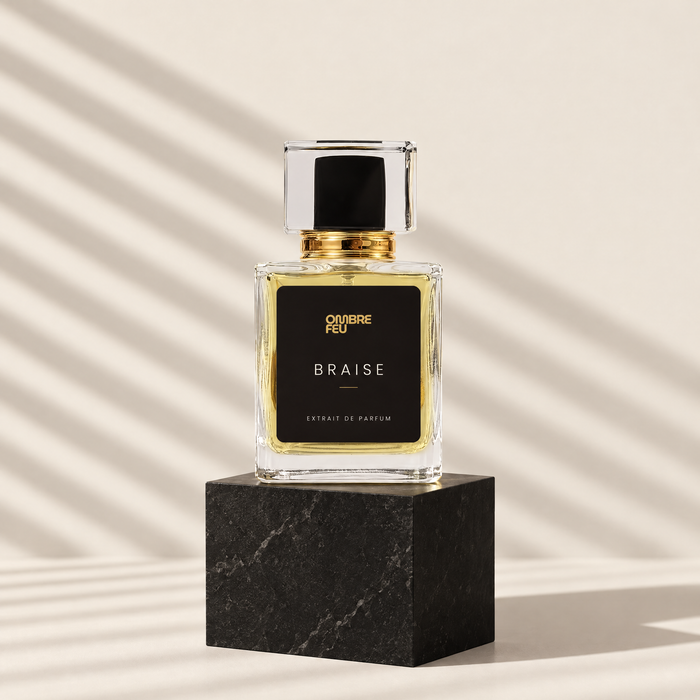
Braise began with a single sentence: the warmth that remains long after the evening has fallen quiet. This became an extrait de parfum with 30% fragrance oil, a spicy opening of grapefruit, cardamom, pink pepper and bergamot, a heart of cinnamon, saffron, iris and clary sage, and a base of leather, vanilla, tonka bean, tobacco, sandalwood and amber. Bottled in Germany, in an angular glass bottle with a black cap. How this pyramid feels in detail is described on the page The fragrances.
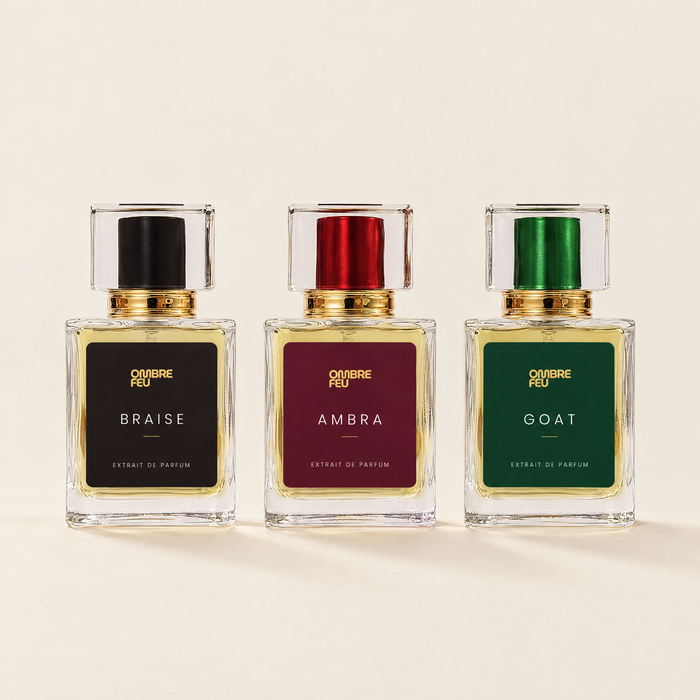
Why there was only this one fragrance at the start – and how GOAT and Ambra turned it into a collection – is told in the article Why Braise?.
Conclusion
A perfume is the result of many small decisions: a clear image at the start, a formula refined over months, precise weighing, weeks of maturation, chilling, filtration and a filling process that protects the fragrance. Add to that a set of rules ensuring that every bottle is safe and traceable. Once you know this, you smell a fragrance differently – not as a fleeting impression, but as something built with patience.
Frequently asked questions
How long does it take to develop a perfume?
From the first idea to the finished product usually takes many months, often more than a year. The longest part is the modifications, in which a formula is adjusted and tested dozens to hundreds of times.
What is maceration in perfume?
Maceration is the maturing period after the fragrance oil and alcohol have been blended. The blend rests for several weeks so that the raw materials bind together and the fragrance becomes rounder and more harmonious.
Why does the packaging say Alcohol Denat.?
Alcohol Denat. is denatured alcohol. It is made undrinkable so that it isn't taxed as drinking alcohol. For the fragrance and its use on the skin, this makes no difference; it is the usual carrier for perfume.
Why is perfume chilled and filtered?
When heavily chilled, components settle out that could later lead to cloudiness, such as waxy fractions of natural oils. Filtering afterwards keeps the perfume clear and stable.
What regulations apply to perfume in the EU?
Perfume is a cosmetic product under the EU Cosmetics Regulation. Before it is sold, it needs, among other things, a safety assessment, a product information file, a notification on the EU notification portal and complete labelling.
- Eau de Cologne, Eau de Toilette, Eau de Parfum, Extrait de Parfum: the differences
- New: Lune Dorée – our captivating Extrait de Parfum for women
- Neu: Nuit Bédouine – unser fruchtig-holziger Extrait de Parfum für Herren
- Ombre & Feu Merch: Hoodies, T-Shirt, Gilet and Accessories at a Glance
- A Small Gift with Fragrance: Perfume Samples for Secret Santa and St Nicholas' Day
- Perfume for New Year's Eve: Which Scent Lasts All Night?
- Perfume for the Christmas Party: Subtle, Warm and Just Right
