


Can perfume expire? How to store your fragrance properly
Perfume has no fixed expiry date and usually keeps for several years after opening if stored somewhere cool, dark and dry. What the open-jar symbol means and how to tell when a perfume has turned.

Sooner or later, everyone finds an old bottle at the very back of the cupboard and wonders: can I still wear this? The short answer: usually, yes. Perfume doesn’t go off like milk, but it does change – and how quickly depends above all on how you store it.
In short: Perfume has no fixed expiry date. Unopened and well stored, it usually keeps for many years; once opened, the open-jar symbol on the packaging gives a guideline in months. The three enemies of any fragrance are light, heat and oxygen. Keep them away, and you’ll still be wearing your fragrance years later exactly as it was meant to smell.
- Store it somewhere dark and cool, at an even temperature – ideally in its box
- Not in the bathroom, not on the windowsill, not in the car
- A fragrance that has turned smells sour or metallic at the opening
- A slightly darker colour on its own is not a sign of spoilage
Why perfume has no expiry date
In the EU, cosmetics only need to carry a best-before date if they keep for less than 30 months. Perfume almost always lasts well beyond that – the high alcohol content acts as a preservative. So instead of a date, you’ll find a small symbol: an open jar with a number and an “M”, such as 24M or 36M.
This is the PAO indication (Period After Opening). It states the minimum number of months the product stays in good condition after it is first opened. With a spray bottle, that period starts with the first spray. The figure is a guideline, not a hard limit: well-stored fragrances often remain stable much longer, while poorly stored ones can fade sooner.
How long does perfume keep? Guidelines at a glance
| Condition | Guideline | What matters |
|---|---|---|
| Unopened, in its box, stored in the dark | usually many years | Even temperature, no light |
| Opened, well stored | as per the PAO symbol, often 24–36 months | Cap on, box, away from the bathroom |
| Opened, in the bathroom or in the sun | sometimes much shorter | Heat, light and humidity speed up oxidation |
| Small decant for on the go | a few weeks to months | Lots of air, lots of movement, often warm |
What happens to a fragrance as it ages
Perfume consists of alcohol and fragrance oil – and fragrance oil is a blend of dozens to hundreds of individual substances. Some of them react with oxygen, others break down under UV light, and heat speeds up both. The result is called oxidation.
The top note is affected first. Citrus oils such as bergamot or lemon are particularly sensitive. That is why an ageing fragrance loses its fresh opening first, while the heavy base notes of woods, resins and vanilla stay stable for a long time. Warm, woody-sweet compositions therefore tend to age more gently than purely fresh fragrances.
Which fragrances age faster
| Fragrance family | Sensitivity | Why |
|---|---|---|
| Citrus, fresh, aquatic | high | Many light top notes that are prone to oxidation |
| Floral, green | medium | Delicate floral notes lose clarity over time |
| Woody, spicy | fairly low | Heavy, stable base |
| Amber, vanilla, tobacco | low | Resins and vanillin are very durable |
Concentration plays a part too. An extrait de parfum with plenty of fragrance oil and little alcohol tends to change in the details rather than as a whole. What defines this concentration level is explained in Extrait de Parfum – what is it?.
The three enemies of your perfume
1. Light
UV radiation breaks down fragrance molecules. A bottle on a sunny windowsill can lose noticeably over a single summer. Dark glass offers some protection, but not complete protection. The best shield from light is the original box.
2. Heat and temperature fluctuations
It isn’t only heat that does damage, but above all the constant switching between warm and cold. That is exactly what happens in the bathroom: steam in the shower, then cooling down, every day. The same applies to the glovebox in a car. Room temperature or slightly below is ideal, kept as constant as possible.
3. Oxygen
The more air there is in the bottle, the faster the remainder oxidises. A nearly empty bottle therefore ages faster than a full one. Spray bottles have the advantage here, as they stay largely sealed. Always put the cap back on, and don’t decant the fragrance into open containers unnecessarily.
The right place: a short checklist
| Place | Suitable? | Why |
|---|---|---|
| Wardrobe, chest of drawers, drawer | Yes | Dark, even temperature |
| In the original box | Ideal | Complete protection from light |
| Bathroom | No | Humidity and daily temperature fluctuations |
| Windowsill, shelf in the sun | No | UV light and heat |
| Car | No | Extreme heat in summer, cold in winter |
| Fridge | Not necessary | Condensation when taken out, other odours |
The fridge tip is a persistent one. For everyday use, it achieves nothing: the fragrance develops less well when cold, and moving it back and forth between the fridge and room temperature is precisely the kind of fluctuation you want to avoid.
Handling the bottle properly every day
- Don’t shake it. A perfume is a finished solution. Shaking only stirs up extra oxygen.
- Put the cap back on after every use. It protects the spray head from dust and keeps the opening clean.
- Store it upright. That keeps the liquid away from the spray mechanism and stops anything leaking.
- Don’t decant into open containers. Decorative carafes look lovely but let air get to the fragrance.
- Use it rather than save it. A fragrance kept in the cupboard for years “for special occasions” changes all the same. Wear it.
How to tell a fragrance has turned
- The opening smells sour, metallic or like nail varnish. This is the clearest sign. The fresh top notes have disappeared or changed.
- The fragrance seems flat. It smells only of alcohol and then of an indistinct base.
- The consistency has changed. Streaks, cloudiness or sediment are a warning sign.
A change in colour on its own, however, is not a reliable indicator. Fragrances with a high proportion of vanilla or vanillin often darken slightly over time without the scent getting any worse. What counts is your nose, not your eyes.
A note on safety: if an old fragrance suddenly stings or reddens the skin, stop using it. Oxidised fragrance substances can irritate the skin more than fresh ones. Which substances play a role here and how to read the information on the pack is explained in Reading perfume ingredients.
Checking an old bottle – step by step
- Look at the PAO symbol. Think roughly about when you first used the bottle.
- Spray once onto a test strip or a tissue. That way you smell the opening without wearing it on your skin straight away.
- Smell it immediately and after ten minutes. If the start is sour but the rest still feels coherent, the fragrance has suffered but is often still wearable.
- Test on a small patch of skin. No redness, no stinging? Then there’s little reason not to use it up.
- If in doubt, keep it off your skin. A fragrance that has turned can still serve as a room scent on a piece of fabric.
On the go: bottle or decant?
For travel and the gym bag, a small atomiser filled from the large bottle is worthwhile. That way the main bottle stays at home in the dark, and you expose only a small amount to heat and movement. Only decant what you’ll use in the next few weeks. How many sprays make sense is covered in the seven mistakes when applying perfume.
Perfume when travelling
When you travel, all three enemies meet at once: a warm car, a sunny hotel desk, a humid hotel bathroom. A few habits help:
- In your toiletry bag, not on top. Packed between clothes, the bottle stays protected from light and temperature peaks.
- Into the wardrobe at the hotel. The bedside table or a drawer is better than the shelf in the bathroom.
- Don’t leave it in a parked car. Not even for an hour in summer.
- Check the hand luggage rules. Quantity limits apply to liquids on planes; a small atomiser is the more convenient solution here than the large bottle. What exactly is allowed and how to pack properly is explained in Perfume in hand luggage.
Is it worth keeping a spare?
If you love a fragrance, you sometimes buy a second bottle straight away. That’s no problem, as long as the spare stays unopened, in its box and in the dark. An unopened bottle has hardly any contact with oxygen and ages much more slowly than one that has been opened. Only open the second when the first is empty – its PAO period then only starts with the first spray.
Typical storage mistakes
- The bottle as bathroom decor. Nice to look at, but the worst place in the home.
- The box in the recycling. It’s the simplest and most effective protection from light you have.
- Perfume in the glovebox. In summer a car heats up enormously – one of the fastest ways to ruin a fragrance.
- Too many bottles open at once. If you rotate ten fragrances, you use each one up more slowly. That makes proper storage all the more important.
Storage and longevity on the skin
Two things are often confused: how long a perfume keeps in the bottle and how long it lasts on the skin. But the two are connected. An oxidised fragrance doesn’t just lose its top note; it wears shorter and flatter overall. So if you store your bottle well, you also get more from it on the skin. The other factors are covered in How long does perfume last?, and the terms that go with them in the glossary of perfume terms.
And with Braise?
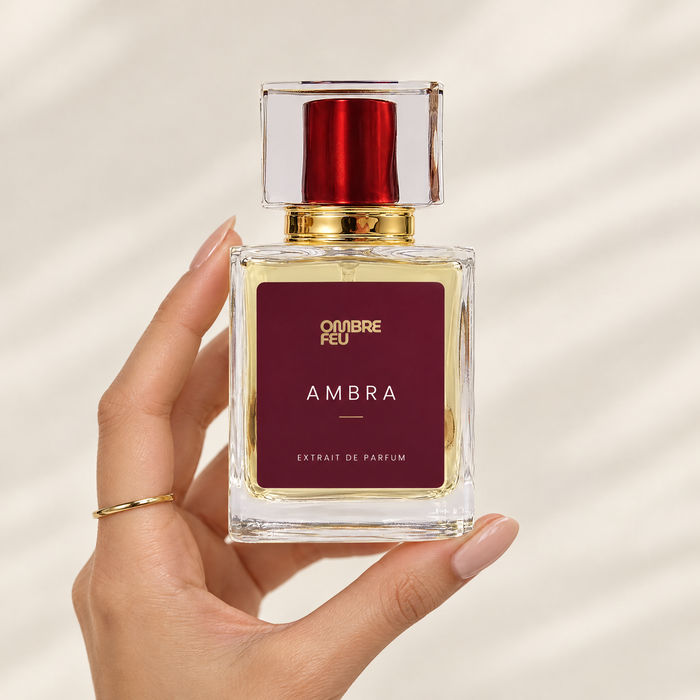
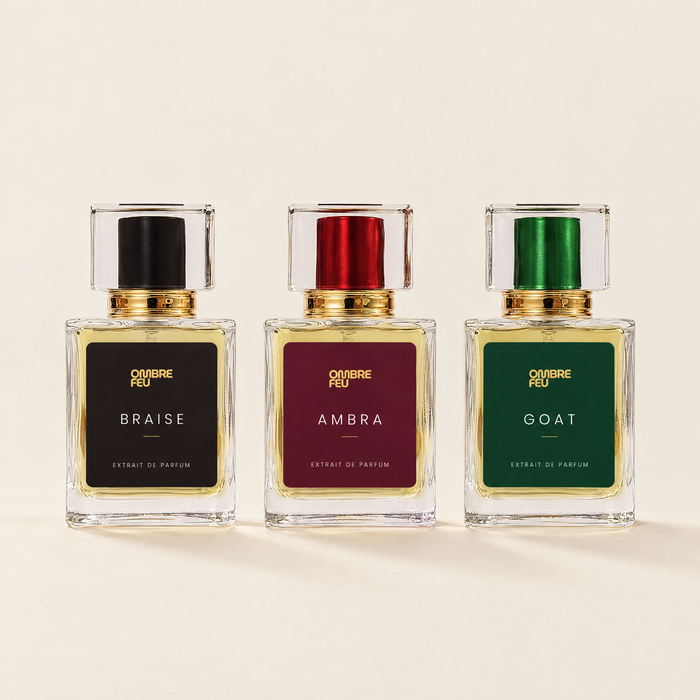
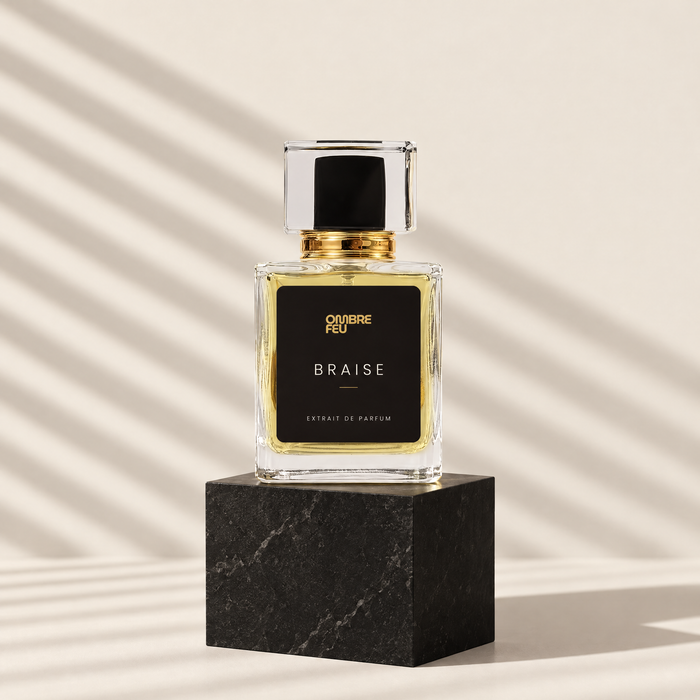
Braise – like GOAT and Ambra – comes in an angular glass bottle with a coloured cap: black for Braise, green for GOAT, red for Ambra. All three fragrances in the collection are extraits de parfum with 30% fragrance oil, bottled in Germany and good for 36 months after opening. Thanks to their warm, woody or creamy-sweet base, they belong to the fragrance families that age gently.
Our advice is nonetheless the same as for any fragrance: keep the box, store the bottle in it, away from the bathroom. You’ll find all mandatory information on our Ingredients & product safety page, and more answers in the FAQ.
Conclusion
Perfume doesn’t expire on a particular day; it ages – faster or more slowly, depending on how you treat it. Stored dark, cool, at an even temperature and well sealed, a fragrance stays stable for years. And if you’re unsure, it’s not the label that decides, but your nose.
Frequently asked questions
Can perfume expire?
Perfume has no fixed expiry date, because the high alcohol content acts as a preservative. It can, however, oxidise through light, heat and oxygen. It then loses its fresh top note first and smells sour or metallic at the opening.
What does the open-jar symbol on the packaging mean?
This is the PAO indication (Period After Opening). The number with the M, for example 36M, states the minimum number of months the product stays in good condition after it is first opened. It is a guideline, not a fixed limit.
How long does an unopened perfume keep?
Stored somewhere dark and cool at an even temperature, an unopened perfume usually stays stable for many years. Warm, woody fragrances generally age more gently than very fresh, citrus-heavy compositions.
Where should perfume be stored?
Ideally in its original box in a cupboard or drawer at room temperature. The bathroom, the windowsill and the car are unsuitable, because light, humidity or strong temperature fluctuations there make the fragrance age faster.
Should perfume be kept in the fridge?
For everyday use, this isn't necessary. Condensation can form when you take it out, and the constant switching between cold and warm does more harm than good.
Is a perfume that has darkened bad?
Not necessarily. Fragrances with a lot of vanilla or vanillin often darken slightly over time without the scent getting any worse. What matters is whether the fragrance smells sour, metallic or flat when applied.
- Eau de Cologne, Eau de Toilette, Eau de Parfum, Extrait de Parfum: the differences
- New: Lune Dorée – our captivating Extrait de Parfum for women
- Neu: Nuit Bédouine – unser fruchtig-holziger Extrait de Parfum für Herren
- Ombre & Feu Merch: Hoodies, T-Shirt, Gilet and Accessories at a Glance
- A Small Gift with Fragrance: Perfume Samples for Secret Santa and St Nicholas' Day
- Perfume for New Year's Eve: Which Scent Lasts All Night?
- Perfume for the Christmas Party: Subtle, Warm and Just Right
