


Which Fragrance Suits Me? A Guide for Men
You find the fragrance that suits you in three steps: choose a fragrance family, test it on your own skin and wait a full day. Six fragrance families, four questions and a testing method for men.

Most men buy their fragrance like this: they walk into a perfumery, have five strips sprayed, can’t smell anything any more after the third and take the one with the best-looking bottle. That rarely works. There is a systematic way – and it takes no longer.
You find the right fragrance in three steps: narrow down the fragrance family, test no more than two candidates on your skin per visit, and decide only after at least four hours. The most common mistake is buying on the first impression – that belongs to the top note and is over after fifteen minutes.
- Six fragrance families cover practically every men’s fragrance
- Two fragrances are enough: one for warm weather, one for cold
- Always test on your skin, never decide on paper
- Two fragrances per visit at most – after that your nose can barely tell them apart
Step 1: Narrow down the fragrance family
Almost every men’s fragrance can be assigned to one of six families. Once you know which one you feel at home in, you have already made most of the choice.
| Family | Typical notes | Effect | Suits |
|---|---|---|---|
| Fresh / aquatic | Bergamot, lemon, marine notes | Clean, unobtrusive, youthful | Summer, sport, the office |
| Aromatic / fougère | Lavender, sage, coumarin, oakmoss | Classically masculine, well groomed | Everyday, work, all year round |
| Woody | Cedarwood, sandalwood, vetiver | Calm, grown-up, understated | The office, autumn, everyday |
| Spicy | Cardamom, pepper, cinnamon, nutmeg | Warm, present, full of character | Autumn, winter, evening |
| Sweet-woody / oriental | Vanilla, tonka bean, amber, tobacco | Intimate, sensual, memorable | The cold months, evening, dates |
| Leathery / smoky | Leather, birch tar, oud, frankincense | Edgy, distinctive, polarising | Evening, special occasions |
A shortcut that works surprisingly well: think of smells you like in everyday life. Freshly sawn wood, cinnamon in the kitchen, an old leather jacket, wet earth after rain, citrus peel. Whatever draws you in almost always points towards the right family.
Which type are you?
Your daily life offers clues too. The following types are not pigeonholes, but they are good starting points:
- The pragmatist: Lots of office time, lots of meetings, little desire for attention. Aromatic or woody with a fresh top note – well groomed without standing out.
- The outdoor type: Cycling, hiking, gardening. Fresh, green or fresh-spicy with vetiver in the base. Anything that smells of air and wood.
- The night owl: Dinners out, bars, concerts, long conversations. Spicy or sweet-woody – fragrances that work up close and stay in the memory.
- The classicist: Suit, leather shoes, tradition. Fougère or leathery-spicy, with a clear structure and no fashionable gimmicks.
If you recognise yourself in two types, you have often already found your two fragrances: one for the day, one for the evening. If you want to get to know the spicy direction better, you will find an overview on our page Spicy fragrance for men.
Step 2: Four questions that halve the choice
- When will you mainly wear the fragrance? During the working day you need something that carries one metre, not five. In the evening it can be more.
- In which season? Cold swallows light notes, heat amplifies sweetness. More on this in our article on fragrances for autumn and winter.
- How close do people get to you? If you work in an open-plan office or often take the train, choose something restrained – or simply apply less. Tips on this are in Fragrance at the office.
- Do you want to stand out or fit in? Both are legitimate. A leathery, smoky fragrance gets comments; an aromatic one is rarely noticed and rarely found intrusive.
Step 3: Test properly
How you test decides the quality of your purchase more than the selection before it. Here is how:
- On your skin. Paper only shows the opening. Only on skin does the base react to warmth and pH.
- Two per visit at most, one on each forearm. After that your nose is overwhelmed.
- No coffee beans. The popular trick doesn’t reset your sense of smell, it only distracts it. Fresh air helps more.
- Walk away. Leave the shop, do something else, smell again after two and after five hours.
- Ask someone. After two hours you barely notice your own fragrance. Others still do.
What you experience in the process – the shift from top to heart to base – is explained in our article on top, heart and base notes. And why the same fragrance smells different on you than on a friend is covered in Why does perfume smell different on everyone?.
Buying online without smelling first
If you order online, you can’t test – which makes reading the description properly all the more important. Pay less attention to the top notes, which fade quickly, and more to the heart and base. If you find notes from your family there, that is the best clue. Descriptions such as “warm and spicy” or “fresh and woody” also help you place it. And check the right of withdrawal before you buy: for sealed perfumes it usually only applies as long as the seal is intact.
Step 4: Choose the concentration
Once you have found your direction, the question remains how strong the fragrance should be. The name on the bottle tells you how much fragrance oil it contains:
| Name | Fragrance oil (typical) | For whom |
|---|---|---|
| Eau de Toilette | approx. 5–15% | heat, sport, those who like to spray generously |
| Eau de Parfum | approx. 15–20% | a solid all-rounder for day and evening |
| Extrait de Parfum | approx. 20–40% | those who spray in the morning and want to smell good until the evening |
For a fragrance that needs to last all day, an eau de parfum or an extrait is the safe choice; an eau de toilette suits heat and confined spaces. Why an extrait is not louder but above all denser and longer-lasting is explained in Extrait de parfum explained.
How many fragrances do you really need?
Two. One for warm months and daytime, one for the cold and for evenings. Even people who own more usually end up wearing two of them in practice. The two should be clearly different: a bright, fresh or woody fragrance for daytime, the office and summer, and a warmer, spicy or sweet-woody one for evenings, autumn and winter. Two similar fragrances, on the other hand, add little – you end up reaching for the same one every time.
Over time, one of these two can become a signature scent – the one people think of when they think of you. How to get there is described in Finding your signature scent.
Found it – now wear it properly
Even the best fragrance comes across wrong if it is dosed wrong. A few basic rules make sure your new fragrance is received the way you chose it:
- On warm areas of skin: the neck, the nape, the chest. There the fragrance unfolds evenly without becoming overpowering.
- Dose for the occasion: one spray at the office, two in the evening, even three outdoors in the cold. With an extrait, less than you think is almost always enough.
- Don’t rub: simply let it dry. Rubbing makes the top notes fade faster.
- Don’t reapply because you can’t smell it any more: your nose gets used to your own fragrance. Others still notice it.
- Store it properly: cool, dark, not in the bathroom. That way the fragrance stays for months just as it was when you bought it.
Common mistakes when buying fragrance
- Buying on the top note. The first impression is over within minutes. But you wear the fragrance for hours.
- Testing too many fragrances at once. From the third one on, the impressions blur.
- Copying someone else’s fragrance. What smells great on a friend can come across quite differently on your skin.
- Deciding on the bottle alone. A beautiful bottle is a bonus, not a criterion.
- Looking for one fragrance for everything. A single fragrance for high summer, the office and winter evenings is almost always a compromise.
What you can safely ignore when choosing
- Age recommendations. No fragrance family becomes unsuitable after a certain age. Only the dosage and the occasion change.
- The length of the note list. Twenty listed notes do not mean more quality than five. Often the short list is the more honest one.
- Reviews from people with different skin. No review can tell you whether a fragrance turns creamy or powdery on you.
- The label “unisex” or “for men”. It describes a marketing decision, not a property of the liquid.
If you lean towards sweet-woody
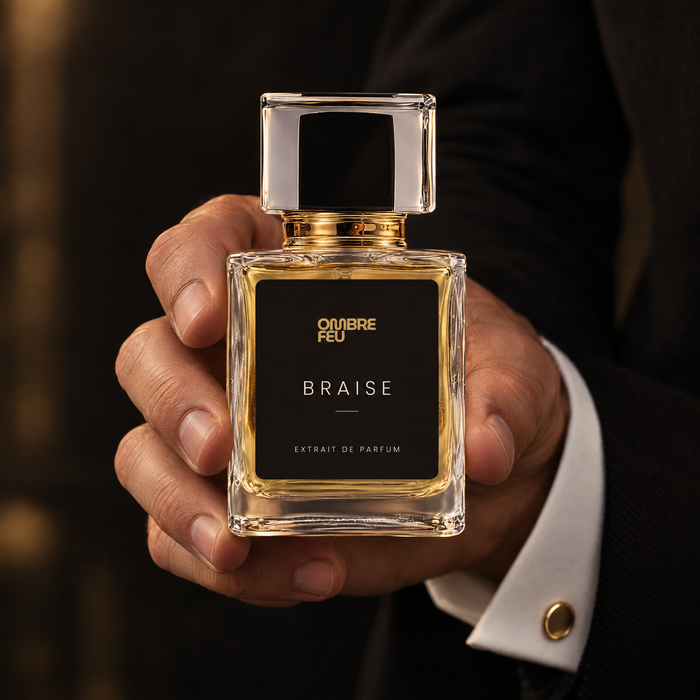
Then Braise is a candidate. The fragrance opens spicy with grapefruit, cardamom, pink pepper and bergamot, grows warmer through cinnamon, saffron, iris and clary sage, and ends in a base of leather, vanilla, tonka bean, tobacco, sandalwood and amber. Extrait de parfum with 30% fragrance oil, 50 ml, bottled in Germany, 9–14 hours on the skin.
It is not an all-rounder. In high summer and in a cramped open-plan office it is the wrong choice. For cool evenings when you stand close together, it is built for exactly that.
If you like it brighter and fruitier
For day and evening there is GOAT – radiant and sweet-woody with bergamot, blood orange, fig, honey and sandalwood. GOAT is for men looking for a bright, warm fragrance. Together with Braise it forms a well-matched duo: bright and fruity for the day, leathery and warm for the evening. You will find both under Men’s fragrances, and with our 3 for 2 – mix & match offer you can combine them freely.
Conclusion
Which perfume suits you is not a matter of luck. First narrow down the fragrance family, answer the four questions on time of day, season, closeness and effect, test no more than two fragrances on your skin and decide only after a few hours. Then choose a concentration that fits your day. In the end you will usually have two fragrances – one for warm weather, one for cold – and the certainty that both truly belong to you.
Frequently asked questions
How do I find out which perfume suits me?
In three steps: first narrow down the fragrance family – fresh, woody, spicy, sweet-woody, aromatic or leathery. Then test no more than two candidates per visit on your skin, not on paper. And decide only after at least four hours, once the base note is there.
How many fragrances should a man own?
Two are enough for most: a lighter one for warm months and daytime situations, a heavier one for cold weather and evenings. A third for special occasions is a luxury, not a necessity.
Does age matter when choosing a fragrance?
Less than is often claimed. There is no fragrance family that would be unsuitable above a certain age. What changes is rather the dosage and the context – a very sweet gourmand comes across differently at work than at the weekend, regardless of your year of birth.
Can you buy a fragrance based on its description?
Only to a limited extent. Lists of notes say something about the direction, but nothing about how the composition behaves on your skin. Skin pH and sebum production noticeably change vanilla, amber and musk in particular. A sample is always the better investment than a review.
What do I do if I no longer like my own fragrance?
First check whether it has turned: a darker colour and a sour opening point to oxidation. If not, your taste has usually shifted – that is normal and is mostly a move from fresh towards spicy or woody, rarely the other way round.
What is the quickest way to identify my fragrance family?
Through smells you like in everyday life. Anyone who enjoys the smell of freshly cut wood, cinnamon or leather almost always ends up with woody, spicy or leathery compositions. Anyone who likes lemon, freshly washed laundry and sea air ends up with fresh ones.


- Eau de Cologne, Eau de Toilette, Eau de Parfum, Extrait de Parfum: the differences
- New: Lune Dorée – our captivating Extrait de Parfum for women
- Ombre & Feu Merch: Hoodies, T-Shirt, Gilet and Accessories at a Glance
- Perfume in Hand Luggage: Flying Rules and How to Keep Your Fragrance Safe on the Road
- A Small Gift with Fragrance: Perfume Samples for Secret Santa and St Nicholas' Day
- Christmas Gift for Her: How to Find the Right Perfume
- Christmas Gift for Him: Which Perfume Really Suits Him?
