
Sillage, projection, longevity: perfume terms explained plainly
Sillage, projection, longevity, accord, flanker, decant: the 20 most important terms from the world of fragrance, briefly defined, with examples and without the jargon.
Read your way into fragrance forums or reviews and within two sentences you run into terms that nobody explains. Sillage, projection, longevity, accord, flanker. Most of it is straightforward, once someone defines it properly. Here is the glossary, arranged by subject rather than alphabetically.
Three terms get confused more often than any others. Projection is the radius within which your fragrance is noticed while you are there. Sillage is the trail that remains once you have left. Longevity is the duration in hours. The three are independent of one another.
- Projection = radius now
- Sillage = trail afterwards
- Longevity = duration in hours
- Concentration governs the duration above all, raw materials the reach
How a fragrance behaves
Sillage
French for the wake a ship leaves behind. It refers to the scent others still notice after you have walked on. Strong sillage usually comes from musk, amber and resin notes. It is not a mark of quality but a property: in a crowded lift, little sillage is the kinder choice.
Projection
The radius within which your fragrance is noticed while you are present. A fragrance with high projection fills a room; one with low projection is only perceptible at arm's length. Either can be the intention, as an evening fragrance may project while an office fragrance should not.
Longevity
The number of hours a fragrance remains perceptible on the skin. It depends on concentration, raw materials, skin type and how it is applied. Rough figures and the main variables are set out in our piece How long does perfume last?
Skin scent
The phase in which a fragrance sits so close to the body that it can only be smelled from a few centimetres away. Almost every fragrance ends there. Some are composed as a skin scent from the outset, which is deliberate rather than a shortcoming.
How a fragrance is built
Fragrance pyramid
The depiction of a fragrance in three phases: top note, heart note, base note. It follows the weight of the molecules, as the light ones evaporate first. Explained in detail in Understanding fragrance notes.
Accord
Several raw materials that together create a new impression, much as several tones form a chord. “Amber” is not a raw material but an accord, classically built from labdanum, vanillin and benzoin. “Leather” and “sea breeze” are accords too, not substances.
Fragrance family
The category a composition is assigned to: fresh, aromatic, woody, spicy, oriental, leathery. Which one suits whom is covered in our guide Which perfume suits me?
Gourmand
A subgroup of the oriental family that puts edible notes to the fore: vanilla, caramel, chocolate, coffee, honey. Gourmands divide opinion more strongly than any other direction.
Fougère
French for fern. One of the oldest structures in men's fragrance: lavender, oakmoss and coumarin. If a fragrance strikes you as “classically masculine, like a good barber's shop”, what you are smelling is usually a fougère.
Chypre
Named after Cyprus. A structure of bergamot, oakmoss, labdanum and patchouli: dry, earthy, elegant. Modern chypres work with substitutes because of restrictions on oakmoss.
How a fragrance is sold
Flanker
A variation on an existing fragrance, sold under the same name with an addition: Intense, Extreme, Elixir, Sport. Flankers can smell markedly different from the original, even though the name does not suggest it.
Reformulation
The reworking of a formula, usually because of changed availability of raw materials or new restrictions. The name stays, the fragrance changes. It is the most common reason behind the phrase “this used to smell different”.
Decant
An original fragrance transferred into a small vial. Legal, and the best way to test a fragrance over several days before buying a whole bottle.
Tester
Genuine stock in plain packaging, intended for the trade. Identical in content to the retail version. Not to be confused with a counterfeit; the differences are set out in How to spot a counterfeit perfume.
Dupe or scent twin
A fragrance deliberately modelled on an original but sold under its own name. What to make of them is covered in Perfume dupes and scent twins.
Technique and ingredients
Concentration
The proportion of fragrance oil: eau de cologne, eau de toilette, eau de parfum, extrait. The differences and what they mean for you are in our comparison Eau de parfum or eau de toilette.
INCI
The internationally standardised nomenclature for cosmetic ingredients. Every pack sold in the EU has to list its ingredients in this form, in descending order of quantity.
Fragrance substances subject to declaration
Around two dozen substances such as linalool, limonene, citral or coumarin, which have to be named individually above a certain concentration because they can trigger allergies in sensitive people. Their presence is normal and not a defect in quality, as they occur in many natural oils.
IFRA
The international association of the fragrance industry. Its standards set out which raw materials may be used and in what maximum quantities. They are the most common reason for reformulations.
Layering
Combining several fragranced products from the same direction: shower gel, lotion, perfume. It extends the effect when the products suit one another, and works against the fragrance when they do not.
Olfactory adaptation
The way the sense of smell becomes accustomed to a constant stimulus. After 20 to 30 minutes you barely notice your own fragrance, while others still do. It is the most common reason for overdosing. What follows from that is in our piece on the seven mistakes when applying perfume.
And in practice?
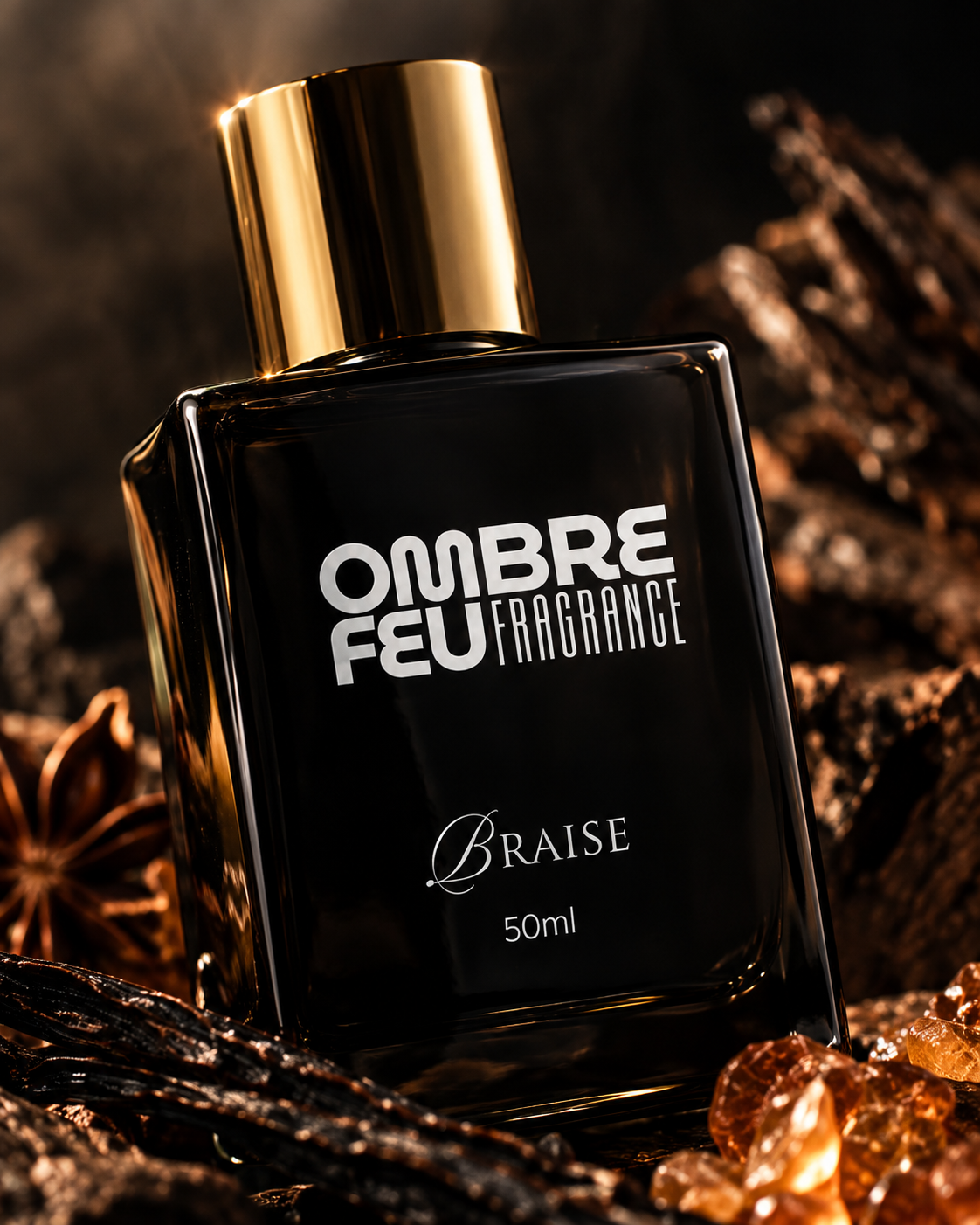
Take Braise #1 as the example. The fragrance has medium projection, moderate sillage and high longevity. Translated, that means it does not fill a room, but it stays. On well cared-for skin the base of vanilla, tonka bean, tobacco, sandalwood and amber carries through a whole evening, while the radius shrinks to arm's length after the first few hours.
That is a deliberate decision: a fragrance for closeness, not for attention.